

LookAnything: A Foundation Model for Holistic Gaze Following
Paper • 2611.32351 • Published • 2

Jiayu Tang1,2,* · Yuchen Zhou2,*,† · Hongsheng Wu3 · Hanjing Ye2 · Ke Huang4
Cheng Wang1 · Yuqin Dai5 · Yufei Huang2 · Yonggen Ling2 · Chao Gou1,†
1Sun Yat-Sen University · 2Tencent Robotics X · 3Futian Laboratory
4Hong Kong Polytechnic University · 5Tsinghua University
*Equal contribution · †Corresponding authors






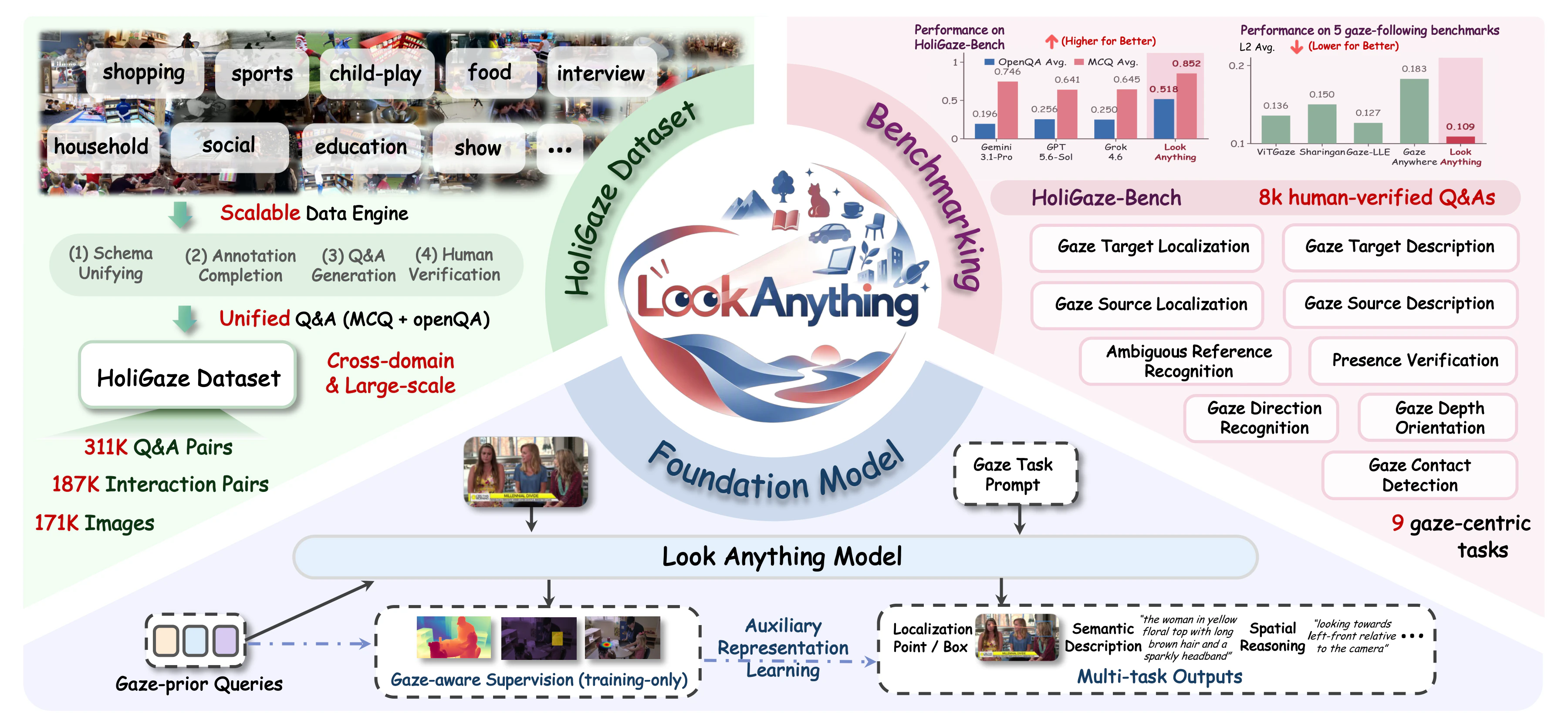
LookAnything brings gaze target localization, description, and reasoning into one instruction-following vision-language model. Its learnable gaze-prior queries capture scene depth, source-head information, and target geometry through auxiliary supervision, removing the need for external head crops or depth maps at inference. The model supports points, boxes, heatmaps, and natural-language answers across diverse scenes and tasks.
The accompanying HoliGaze dataset contains 311K question-answer pairs: a 303K-sample training corpus and HoliGaze-Bench, an 8K-sample human-verified evaluation set. Together they span nine gaze-centric tasks in five capability dimensions.
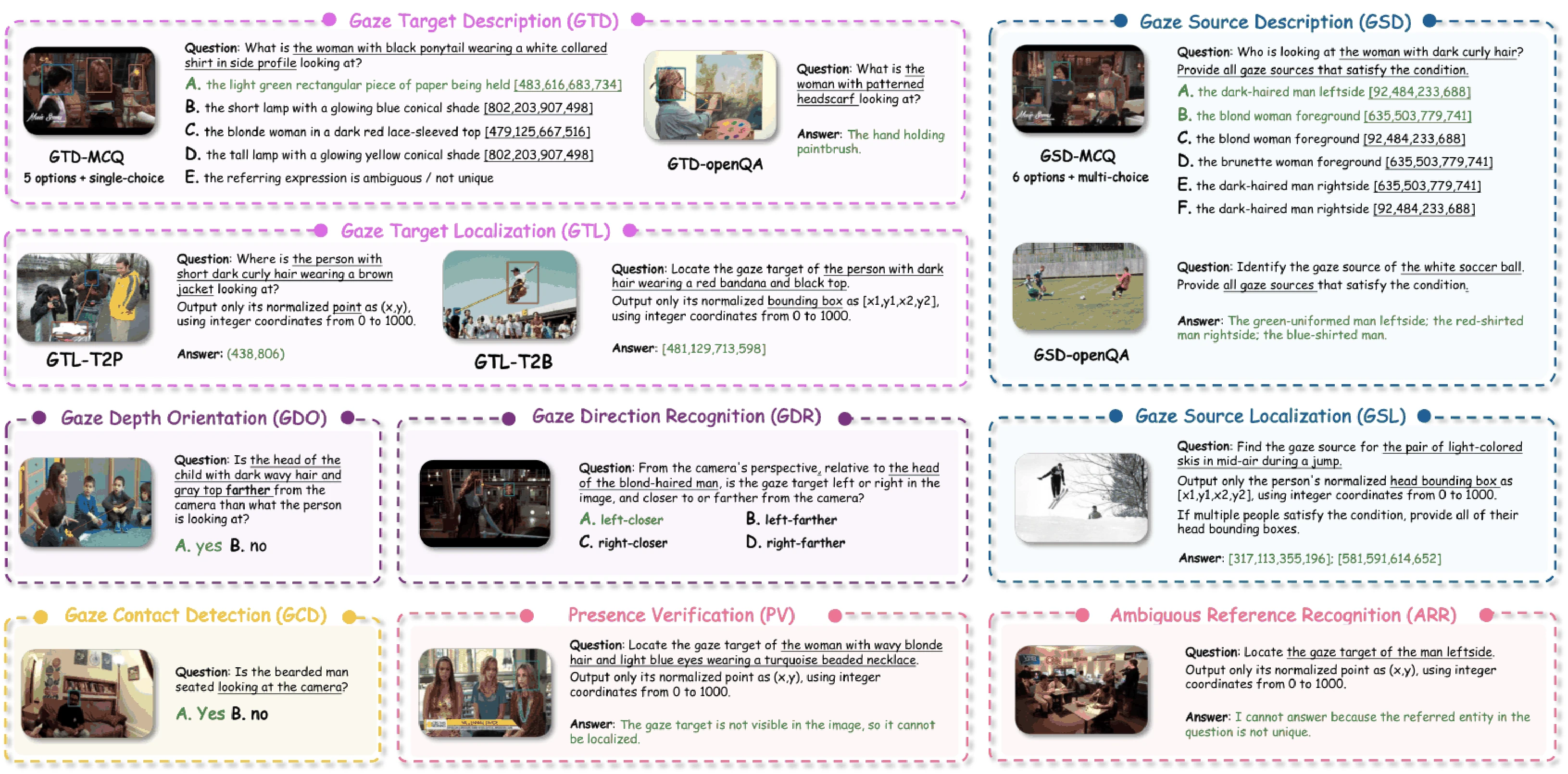
| Capability | Tasks |
|---|---|
| Gaze target understanding | Target localization and description |
| Gaze source understanding | Source localization and description |
| Gaze spatial reasoning | Depth orientation and direction recognition |
| Gaze social interaction | Gaze contact detection |
| Gaze query answerability | Ambiguous reference recognition and presence verification |
HoliGaze-Bench combines open-ended questions and multiple-choice questions. Its 8K evaluation pairs cover 6,143 images and are verified at the instance level.
Run these commands from the root of the LookAnything code repository.
conda create -n lookanything python=3.12 -y
conda activate lookanything
pip install -r requirements.txt
Download the LA-2B inference checkpoint (4.15 GiB) from Hugging Face.
hf download JYT4chenxiyuxi/LookAnything --include "LA-2B/*" --local-dir checkpoints
Both inference scripts load checkpoints/LA-2B/ by default. If you download the files manually, keep this layout.
checkpoints/LA-2B/
├── backbone/
│   ├── config.json
│   ├── generation_config.json
│   └── model.safetensors
├── attend_thing_aux.pt
├── chat_template.jinja
├── config.json
├── processor_config.json
├── tokenizer.json
└── tokenizer_config.json
Replace path/to/image.jpg with the image you want to process.
python predict.py --image path/to/image.jpg
The default task (GTL) predicts a gaze target point and prints the result as JSON. To change the task, prompt, or output fields, edit inference_config.json.
Start the browser demo and HTTP API with serve.py.
python serve.py --host 127.0.0.1 --port 8000
Open the demo at http://127.0.0.1:8000. The API provides GET /health for readiness and POST /predict for inference.
To deploy online, run the same command on your server and point an authenticated HTTPS reverse proxy to 127.0.0.1:8000.
If LookAnything or HoliGaze is useful for your research, please cite:
@article{tang2026lookanything,
  title   = {LookAnything: A Foundation Model for Holistic Gaze Following},
  author  = {Tang, Jiayu and Zhou, Yuchen and Wu, Hongsheng and Ye, Hanjing and Huang, Ke and Wang, Cheng and Dai, Yuqin and Huang, Yufei and Ling, Yonggen and Gou, Chao},
  journal = {arXiv preprint arXiv:2611.32351},
  year    = {2026},
  url     = {https://arxiv.org/abs/2611.32351}
}