⚓ OpenBallast
How much of a bigger model's factual advantage is just memorized trivia,
and can you buy it back with a file instead of parameters? We measured it.
You can: 40–100× cheaper per byte at full precision, ≈15× against the bigger
model's cheapest intact quant.
Small models reason fine. They just don't know much. OpenBallast builds
ballasts: versioned, rank-quantized knowledge artifacts you pair with any
local model. Pick your knowledge level like you pick a GGUF quant. The
triple tier is CC0; the prose tier carries Wikipedia's CC BY-SA; every
artifact states its own license.
Measured (two model families; 50,147 recall probes, 90.5% corpus-linked,
plus a 43,137-probe hallucination suite, 8-way multiple-choice scored from
token probabilities with abstention; open-ended generative numbers are lower
and reported separately in the retrieval results):
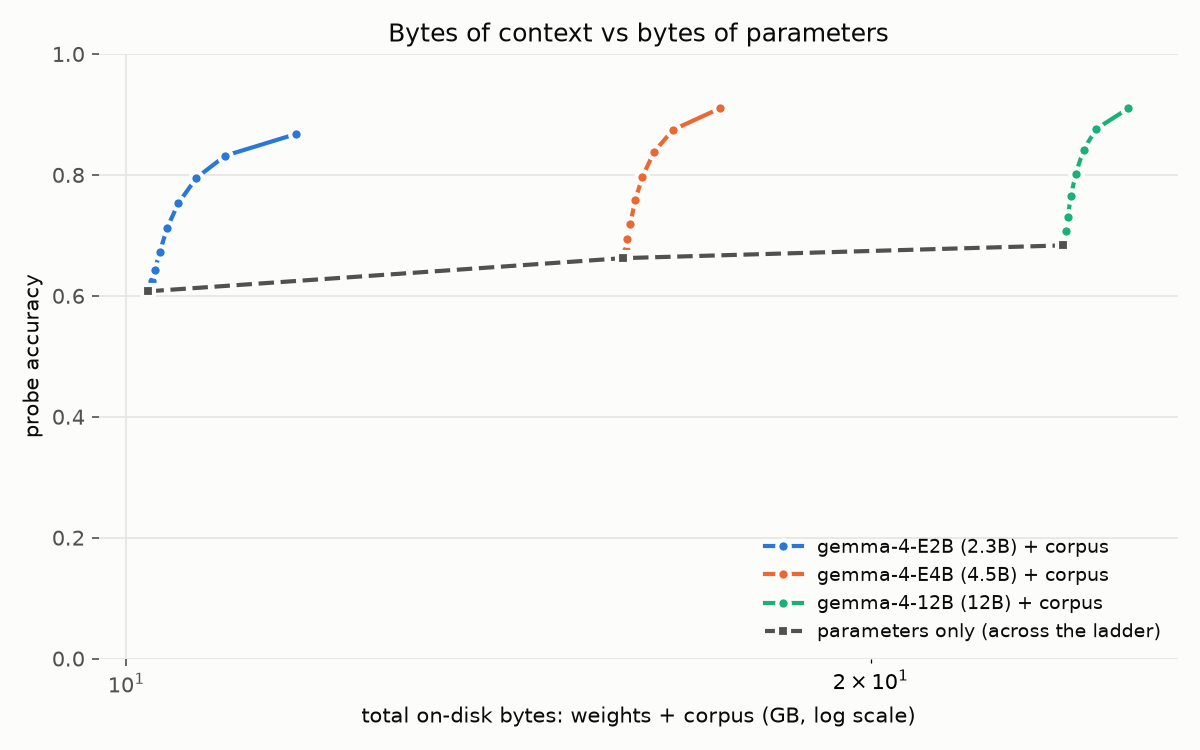
- Raw, Gemma-4's E2B/E4B/12B score 61/66/68%; given the same corpus to look
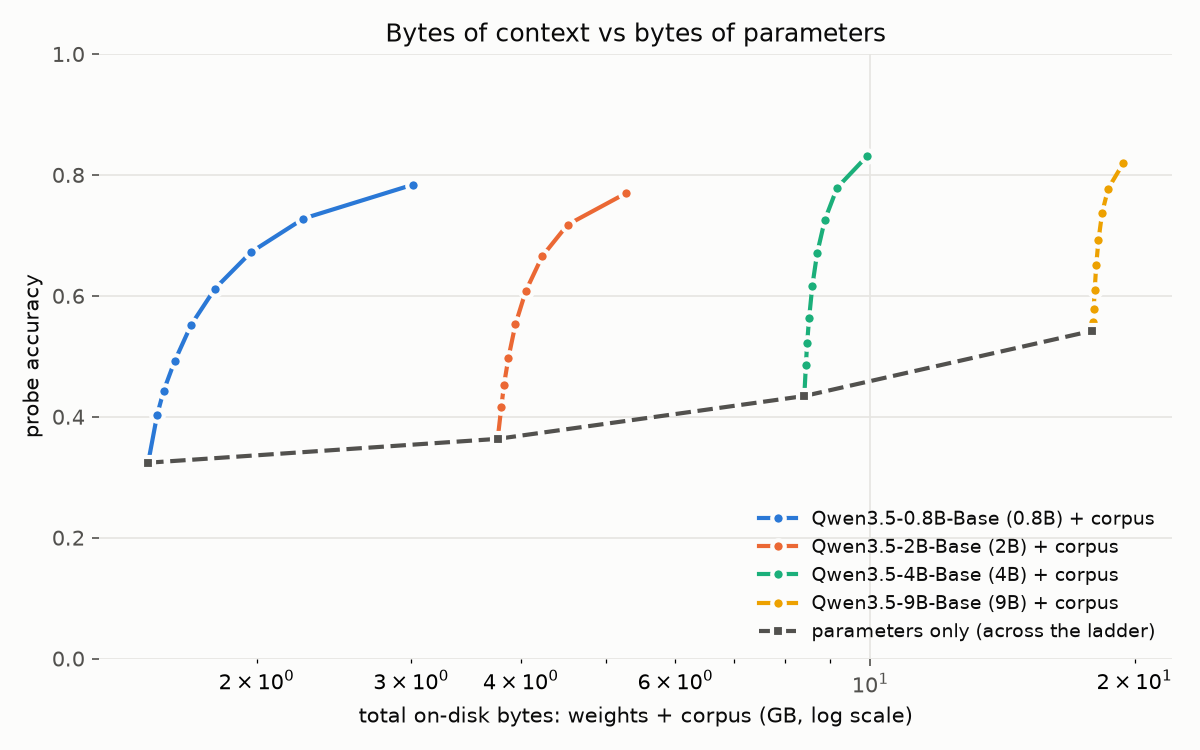
facts up in, all three land at 87–91%. Replicates on Qwen3.5 (0.8B–9B: raw
32–54%, ballasted 77–83%, and the ballasted 4B beats the ballasted 9B).
Size gaps are mostly memorization gaps.
- An E2B + a 470 MB file beats the 12B raw with a real, non-generative
lookup in the loop; the bf16 parameter route costs ≈19 GB. Hallucination
on answerable questions: 0.24 → 0.07.
- On open-ended generation with prose retrieval, a 9B + corpus + a two-pass
support check beats a 12B alone by +17.5 points at less VRAM
(details).
- Grounding cuts multi-hop hallucination 3–20× but raises fabrication on
unanswerable questions: it fixes answerable questions, it does not teach
abstention.
- Quantization damage, split into reading vs recall. Score a quant on the
same probes twice, once from its own weights and once with the evidence in
hand. Recall down but reading held means the quant only forgot, so ballast
it and carry on; reading collapsed too means no corpus buys it back and you
need a bigger quant. The two fail independently: in our sweep one model came
out recall-intact/reading-damaged and another the reverse. This complements
KL divergence rather than replacing it. KL and perplexity measure drift from
a full-precision reference (which at 12B+ is the model you couldn't run) and
answer "did quantization change this model?"; the grounded readout runs on
the quant alone and answers "which capability broke, and can I ship facts to
fix it?" nf4 breaks some models and not others, unpredictably from size, and
only the grounded score tells you which.
- Corpora tuned to a specific model's knowledge gaps lose to the one generic
corpus at every equal-bytes level, a negative result we publish with the
same prominence as the wins.
- 📦 ballast-t0: the triple corpus, 8 quantization levels, CC0
- 📚 ballast-t1: full-body Wikipedia passages, same levels, CC BY-SA (+ CC0 statements sidecar)
- 🎓 ballast-t2: 61 OpenStax textbooks as passages, git-SHA-pinned provenance, CC BY
- 🧪 ballast-evalsets: 50k recall probes + 43k hallucination probes
- 🛠️ ballast-cli (
uvx openballast): pull or build a corpus, serve a grounding proxy/MCP, profile your model, run the three-arm benchmark
- 📖 Thesis + methodology + numbers
- ⚡ Live demo endpoint (MCP):
https://mcp.openballast.org, demo-grade, no SLA, runs on a $0/month stack

