| | --- |
| | license: other |
| | license_name: seallms |
| | license_link: LICENSE |
| | language: |
| | - en |
| | - zh |
| | - id |
| | - vi |
| | - th |
| | pipeline_tag: audio-text-to-text |
| | tags: |
| | - seallms-audio |
| | - speech |
| | - audio |
| | - SEA |
| | --- |
| | <p align="center"> |
| | <img src="https://DAMO-NLP-SG.github.io/SeaLLMs-Audio/static/images/seallm-audio-logo.png" alt="SeaLLMs-Audio" width="20%"> |
| | </p> |
| | |
| | # SeaLLMs-Audio: Large Audio-Language Models for Southeast Asia |
| |
|
| | <p align="center"> |
| | <a href="https://DAMO-NLP-SG.github.io/SeaLLMs-Audio/" target="_blank" rel="noopener">Website</a> |
| | |
| | <a href="https://arxiv.org/abs/2511.01670" target="_blank" rel="noopener">📖 Paper</a> |
| | |
| | <a href="https://huggingface.co/spaces/SeaLLMs/SeaLLMs-Audio-Demo" target="_blank" rel="noopener"> 🤗 DEMO</a> |
| | |
| | <a href="https://github.com/DAMO-NLP-SG/SeaLLMs-Audio" target="_blank" rel="noopener">Github</a> |
| | |
| | <a href="https://huggingface.co/SeaLLMs/SeaLLMs-Audio-7B" target="_blank" rel="noopener">🤗 Model</a> |
| | |
| | <a href="https://huggingface.co/datasets/SeaLLMs/SeaBench-Audio" target="_blank" rel="noopener">🤗 Benchmark</a> |
| | |
| | </p> |
| |
|
| | We introduce **SeaLLMs-Audio**, the multimodal (audio) extension of the [SeaLLMs](https://damo-nlp-sg.github.io/DAMO-SeaLLMs/) (Large Language Models for Southeast Asian languages) family. It is the first large audio-language model (LALM) designed to support multiple Southeast Asian languages, including **Indonesian (id), Thai (th), and Vietnamese (vi), alongside English (en) and Chinese (zh)**. |
| |
|
| | Trained on a large-scale audio dataset, SeaLLMs-Audio demonstrates strong performance across various audio-related tasks, such as audio analysis tasks and voice-based interactions. As a significant step toward advancing audio LLMs in Southeast Asia, we hope SeaLLMs-Audio will benefit both the research community and industry in the region. |
| |
|
| | ### Key Features of SeaLLMs-Audio: |
| |
|
| | - **Multilingual**: The model mainly supports 5 languages, including 🇮🇩 Indonesian, 🇹🇭 Thai, 🇻🇳 Vietnamese, 🇬🇧 English, and 🇨🇳 Chinese. |
| | - **Multimodal**: The model supports flexible input formats, such as **audio only, text only, and audio with text**. |
| | - **Multi-task**: The model supports a variety of tasks, including audio analysis tasks such as audio captioning, automatic speech recognition, speech-to-text translation, speech emotion recognition, speech question answering, and speech summarization. Additionally, it handles voice chat tasks, including answering factual, mathematical, and other general questions. |
| |
|
| | We open-weight [SeaLLMs-Audio](https://huggingface.co/SeaLLMs/SeaLLMs-Audio-7B) on Hugging Face, and we have built a [demo](https://huggingface.co/spaces/SeaLLMs/SeaLLMs-Audio-Demo) for users to interact with. |
| |
|
| |
|
| | # Training information: |
| | SeaLLMs-Audio builts upon [Qwen2-Audio-7B](https://huggingface.co/Qwen/Qwen2-Audio-7B) and [Qwen2.5-7B-Instruct](https://huggingface.co/Qwen/Qwen2.5-7B-Instruct). We replaced the LLM module in Qwen2-Audio-7B by Qwen2.5-7B-Instruct. After that, we do full-parameter fine-tuning on a large-scale audio dataset. This dataset contains 1.58M conversations for multiple tasks, in which 93% are single turn. The tasks can be roughly classified as following task categories: automatic speech recognition (ASR), audio captioning (AC), speech-to-text translation (S2TT), question answering (QA), speech summarization (SS), speech question answering (SQA), chat, math, and fact and mixed tasks (mixed). |
| |
|
| | The distribution of data across languages and tasks are: |
| |
|
| | <p align="center"> |
| | <strong>Distribution of SeaLLMs-Audio training data across languages and tasks</strong> |
| | </p> |
| | |
| | <p align="center"> |
| | <img src="https://DAMO-NLP-SG.github.io/SeaLLMs-Audio/static/data_distribution/dist_lang.png" alt="Distribution of SeaLLMs-Audio training data across languages" width="70%"> |
| | <img src="https://DAMO-NLP-SG.github.io/SeaLLMs-Audio/static/data_distribution/dist_task.png" alt="Distribution of SeaLLMs-Audio training data across tasks" width="70%"> |
| | </p> |
| | |
| | The training dataset was curated from multiple data sources, including public datasets and in-house data. Public datasets includes: [gigaspeech](https://huggingface.co/datasets/speechcolab/gigaspeech), [gigaspeech2](https://huggingface.co/datasets/speechcolab/gigaspeech2), [common voice](https://huggingface.co/datasets/mozilla-foundation/common_voice_17_0), [AudioCaps](https://huggingface.co/datasets/OpenSound/AudioCaps), [VoiceAssistant-400K](https://huggingface.co/datasets/gpt-omni/VoiceAssistant-400K), [YODAS2](https://huggingface.co/datasets/espnet/yodas2), and [Multitask-National-Speech-Corpus](https://huggingface.co/datasets/MERaLiON/Multitask-National-Speech-Corpus-v1). We would like to thank the authors of these datasets for their contributions to the community! |
| |
|
| | We train the model on the dataset for 1 epoch, which took ~6 days to complete on 32 A800 GPUs. |
| |
|
| |
|
| | # Performance |
| | Due to the absence of standard audio benchmarks for evaluating audio LLMs in Southeast Asia, we have manually created a benchmark called **SeaBench-Audio**. It comprises nine tasks: |
| |
|
| | - **Tasks with both audio and text inputs:** Audio Captioning (AC), Automatic Speech Recognition (ASR), Speech-to-Text Translation (S2TT), Speech Emotion Recognition (SER), Speech Question Answering (SQA), and Speech Summarization (SS). |
| | - **Tasks with only audio inputs:** Factuality, Math, and General. |
| |
|
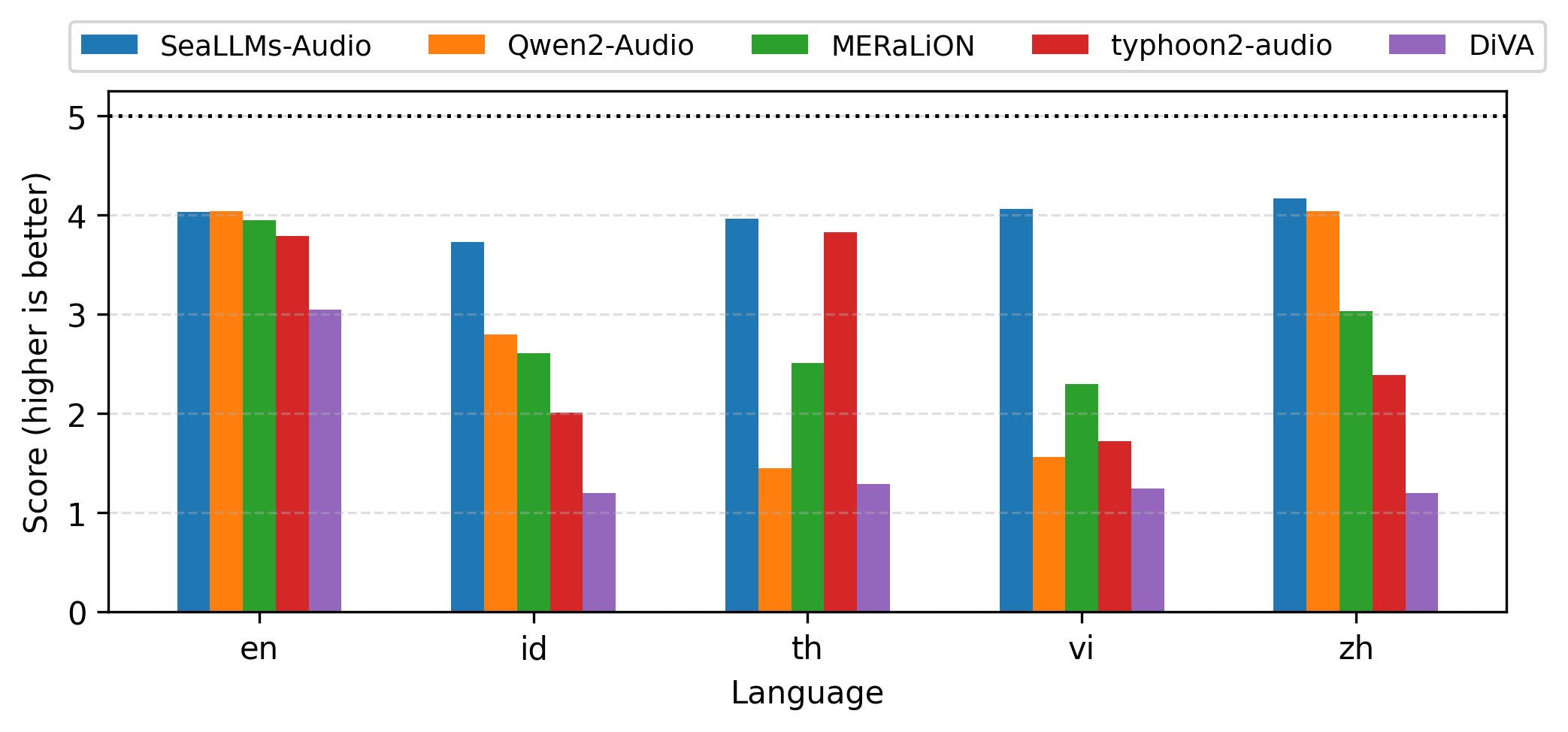
| | We manually annotated 15 questions per task per language. For evaluation, qualified native speakers rated each response on a scale of 1 to 5, with 5 representing the highest quality. |
| |
|
| | Due to the lack of LALMs for all the three Southeast Asian languages, we compare the performance of SeaLLMs-Audio with relevant LALMs with similar sizes, including: [Qwen2-Audio-7B-Instruct](https://huggingface.co/Qwen/Qwen2-Audio-7B-Instruct) (Qwen2-Audio), [MERaLiON-AudioLLM-Whisper-SEA-LION](https://huggingface.co/MERaLiON/MERaLiON-AudioLLM-Whisper-SEA-LION) (MERaLiON), [llama3.1-typhoon2-audio-8b-instruct](https://huggingface.co/scb10x/llama3.1-typhoon2-audio-8b-instruct) (typhoon2-audio), and [DiVA-llama-3-v0-8b](https://huggingface.co/WillHeld/DiVA-llama-3-v0-8b) (DiVA). |
| | All the LALMs can accept audio with text as input. The results are shown in the figure below. |
| |
|
| | <center> |
| |
|
| | **Average scores of SeaLLMs-Audio vs. Other LALMs on SeaBench-Audio** |
| |
|
| |  |
| |
|
| | </center> |
| |
|
| | The results shows that SeaLLMs-Audio achieve state-of-the-art performance in all the five langauges, demonstrating its effectiveness in supporting audio-related tasks in Southeast Asia. |
| |
|
| |
|
| | # Quickstart |
| | Our model is available on Hugging Face, and you can easily use it with the `transformers` library or `vllm` library. Below are some examples to get you started. |
| |
|
| | ## Get started with `transformers` |
| |
|
| | ```python |
| | from transformers import Qwen2AudioForConditionalGeneration, AutoProcessor |
| | import librosa |
| | import os |
| | |
| | model = Qwen2AudioForConditionalGeneration.from_pretrained("SeaLLMs/SeaLLMs-Audio-7B", device_map="auto") |
| | processor = AutoProcessor.from_pretrained("SeaLLMs/SeaLLMs-Audio-7B") |
| | |
| | def response_to_audio(conversation, model=None, processor=None): |
| | text = processor.apply_chat_template(conversation, add_generation_prompt=True, tokenize=False) |
| | audios = [] |
| | for message in conversation: |
| | if isinstance(message["content"], list): |
| | for ele in message["content"]: |
| | if ele["type"] == "audio": |
| | if ele['audio_url'] != None: |
| | audios.append(librosa.load( |
| | ele['audio_url'], |
| | sr=processor.feature_extractor.sampling_rate)[0] |
| | ) |
| | if audios != []: |
| | inputs = processor(text=text, audios=audios, return_tensors="pt", padding=True,sampling_rate=16000) |
| | else: |
| | inputs = processor(text=text, return_tensors="pt", padding=True) |
| | inputs.input_ids = inputs.input_ids.to("cuda") |
| | inputs = {k: v.to("cuda") for k, v in inputs.items() if v is not None} |
| | generate_ids = model.generate(**inputs, max_new_tokens=2048, temperature = 0, do_sample=False) |
| | generate_ids = generate_ids[:, inputs["input_ids"].size(1):] |
| | response = processor.batch_decode(generate_ids, skip_special_tokens=True, clean_up_tokenization_spaces=False)[0] |
| | return response |
| | |
| | # Voice Chat |
| | os.system(f"wget -O fact_en.wav https://DAMO-NLP-SG.github.io/SeaLLMs-Audio/static/audios/fact_en.wav") |
| | os.system(f"wget -O general_en.wav https://DAMO-NLP-SG.github.io/SeaLLMs-Audio/static/audios/general_en.wav") |
| | conversation = [ |
| | {"role": "user", "content": [ |
| | {"type": "audio", "audio_url": "fact_en.wav"}, |
| | ]}, |
| | {"role": "assistant", "content": "The most abundant gas in Earth's atmosphere is nitrogen. It makes up about 78 percent of the atmosphere by volume."}, |
| | {"role": "user", "content": [ |
| | {"type": "audio", "audio_url": "general_en.wav"}, |
| | ]}, |
| | ] |
| | |
| | response = response_to_audio(conversation, model=model, processor=processor) |
| | print(response) |
| | |
| | # Audio Analysis |
| | os.system(f"wget -O ASR_en.wav https://DAMO-NLP-SG.github.io/SeaLLMs-Audio/static/audios/ASR_en.wav") |
| | conversation = [ |
| | {"role": "user", "content": [ |
| | {"type": "audio", "audio_url": "ASR_en.wav"}, |
| | {"type": "text", "text": "Please write down what is spoken in the audio file."}, |
| | ]}, |
| | ] |
| | |
| | response = response_to_audio(conversation, model=model, processor=processor) |
| | print(response) |
| | ``` |
| |
|
| | ## Inference with `vllm` |
| |
|
| | ```python |
| | from vllm import LLM, SamplingParams |
| | import librosa, os |
| | from transformers import AutoProcessor |
| | |
| | processor = AutoProcessor.from_pretrained("SeaLLMs/SeaLLMs-Audio-7B") |
| | llm = LLM( |
| | model="SeaLLMs/SeaLLMs-Audio-7B", trust_remote_code=True, gpu_memory_utilization=0.5, |
| | enforce_eager=True, device = "cuda", |
| | limit_mm_per_prompt={"audio": 5}, |
| | ) |
| | |
| | def response_to_audio(conversation, model=None, processor=None, temperature = 0.1,repetition_penalty=1.1, top_p = 0.9,max_new_tokens = 4096): |
| | text = processor.apply_chat_template(conversation, add_generation_prompt=True, tokenize=False) |
| | audios = [] |
| | for message in conversation: |
| | if isinstance(message["content"], list): |
| | for ele in message["content"]: |
| | if ele["type"] == "audio": |
| | if ele['audio_url'] != None: |
| | audios.append(librosa.load( |
| | ele['audio_url'], |
| | sr=processor.feature_extractor.sampling_rate)[0] |
| | ) |
| | |
| | sampling_params = SamplingParams( |
| | temperature=temperature, max_tokens=max_new_tokens, repetition_penalty=repetition_penalty, top_p=top_p, top_k=20, |
| | stop_token_ids=[], |
| | ) |
| | |
| | input = { |
| | 'prompt': text, |
| | 'multi_modal_data': { |
| | 'audio': [(audio, 16000) for audio in audios] |
| | } |
| | } |
| | |
| | output = model.generate([input], sampling_params=sampling_params)[0] |
| | response = output.outputs[0].text |
| | return response |
| | |
| | # Voice Chat |
| | os.system(f"wget -O fact_en.wav https://DAMO-NLP-SG.github.io/SeaLLMs-Audio/static/audios/fact_en.wav") |
| | os.system(f"wget -O general_en.wav https://DAMO-NLP-SG.github.io/SeaLLMs-Audio/static/audios/general_en.wav") |
| | conversation = [ |
| | {"role": "user", "content": [ |
| | {"type": "audio", "audio_url": "fact_en.wav"}, |
| | ]}, |
| | {"role": "assistant", "content": "The most abundant gas in Earth's atmosphere is nitrogen. It makes up about 78 percent of the atmosphere by volume."}, |
| | {"role": "user", "content": [ |
| | {"type": "audio", "audio_url": "general_en.wav"}, |
| | ]}, |
| | ] |
| | |
| | response = response_to_audio(conversation, model=llm, processor=processor) |
| | print(response) |
| | |
| | # Audio Analysis |
| | os.system(f"wget -O ASR_en.wav https://DAMO-NLP-SG.github.io/SeaLLMs-Audio/static/audios/ASR_en.wav") |
| | conversation = [ |
| | {"role": "user", "content": [ |
| | {"type": "audio", "audio_url": "ASR_en.wav"}, |
| | {"type": "text", "text": "Please write down what is spoken in the audio file."}, |
| | ]}, |
| | ] |
| | |
| | response = response_to_audio(conversation, model=llm, processor=processor) |
| | print(response) |
| | ``` |
| |
|
| |
|
| | ## Citation |
| | If you find our project useful, we hope you would kindly star our [repo](https://github.com/DAMO-NLP-SG/SeaLLMs-Audio) and cite our work as follows. |
| | Corresponding Author: Wenxuan Zhang ([wxzhang@sutd.edu.sg](mailto:wxzhang@sutd.edu.sg)) |
| | ``` |
| | @misc{SeaLLMs-Audio, |
| | title={SeaLLMs-Audio: Large Audio-Language Models for Southeast Asia}, |
| | author={Chaoqun Liu and Mahani Aljunied and Guizhen Chen and Hou Pong Chan and Weiwen Xu and Yu Rong and Wenxuan Zhang}, |
| | year={2025}, |
| | eprint={2511.01670}, |
| | archivePrefix={arXiv}, |
| | url={https://arxiv.org/abs/2511.01670}, |
| | } |
| | ``` |
| |
|
| |
|
| |
|